At some point talking has to become an offer. The Letter of Intent is that moment: a letter to the seller or their broker saying what you'll pay, how the deal is structured, what you need to see, and how long you need.
It's the cheapest serious step in an acquisition. No lawyer has drafted anything yet, no money has moved, and the entire purpose is to find out whether you and the seller are close enough to be worth the expense of finding out properly.
Generate one
The generator is a Premium feature, and it works from a deal you already have in your pipeline — so the business name, location and asking price come across already filled in.
Open the deal and start the LOI
From the deal in Pipeline. Ideally do this after running the documents through diligence, so the price you're about to offer is anchored to earnings you've actually verified rather than the ones you were told.
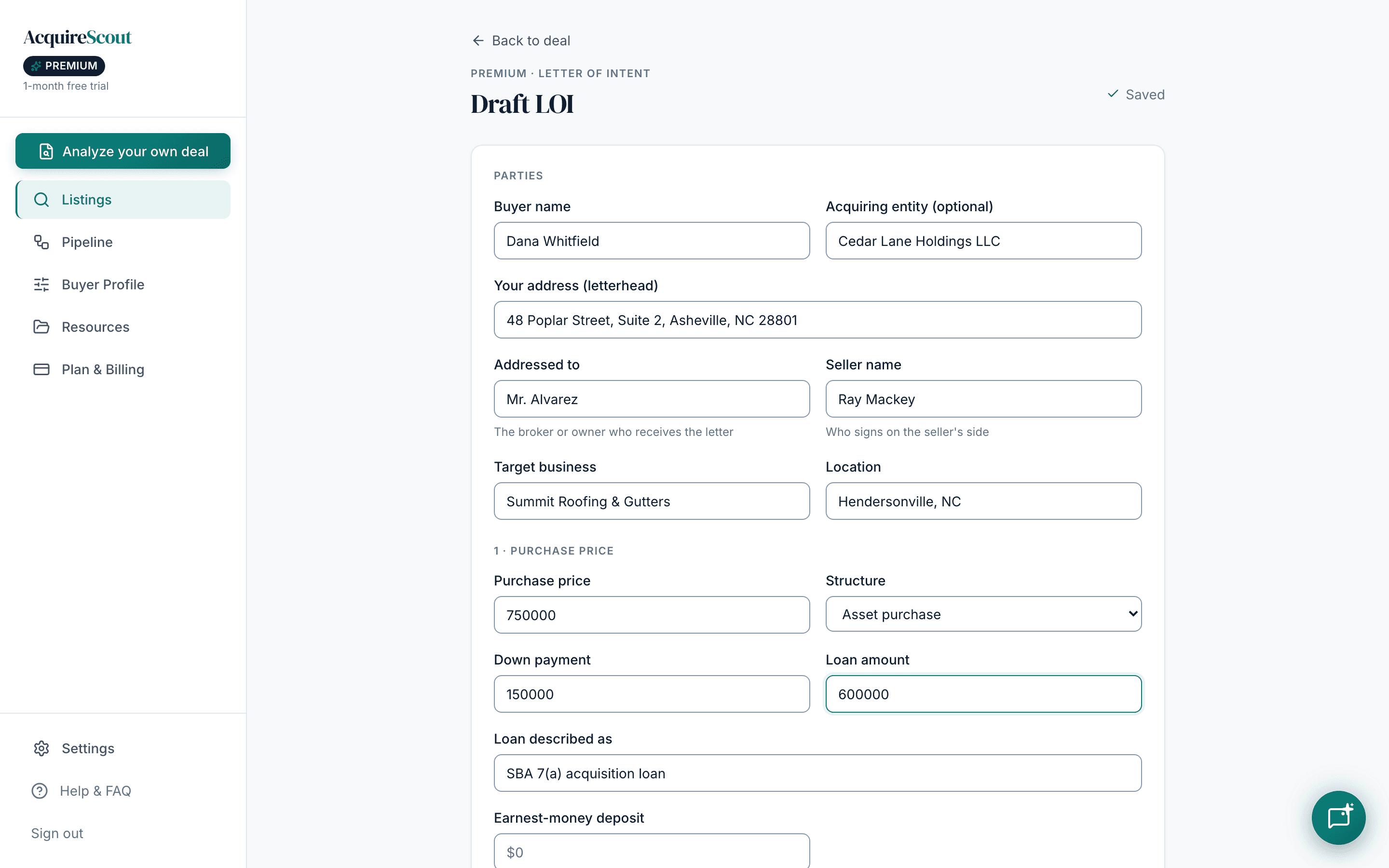
Fill in the parties
Your name, the acquiring entity if you're buying through an LLC, and your address for the letterhead. Then who the letter is addressed to — usually the broker — and the seller, who signs. Those are often different people, and the letter treats them separately.
Set the price and the structure
The purchase price defaults to the deal's asking price; change it to your offer. Choose asset purchase or stock purchase — asset is the usual default for small businesses. Then split the price into the cash down at closing and the loan amount, and describe the loan (it defaults to
SBA 7(a) acquisition loan).Set the terms
Earnest money, your diligence period (30 days by default) and how quickly the seller must produce the document list (5 days). Then the exclusivity period (30 days), how long your offer stands (3 days), and your target closing timeline.
Post-closing: how many months the seller stays on to hand over, at how many hours a week, and the non-compete — 2 years within 50 miles by default.
Choose the document request list
The LOI carries the list of what you want from the seller during diligence. Tick the standard items, add anything specific to this business, and it goes into the letter — so the seller knows exactly what they're agreeing to produce.
Review, edit, export
You get a complete broker-style letter. Read it end to end, edit anything that doesn't fit, and export it.
Choosing your numbers
Every default above is a conventional starting point, not a recommendation — the generator pre-fills them so you have a complete letter, not so you accept them. The three that deserve a decision rather than a default are the purchase price, the diligence period and the exclusivity period; what an LOI does, and what binds you explains what's at stake in each.
The one that's specific to working this way: your purchase price should reflect the earnings the diligence report verified, not the ones the listing stated. That's the whole reason to draft the LOI from an analysed deal.
After it's signed
Move the deal to LOI, then to Due Diligence as the documents arrive. The clock you just agreed to is running, and the diligence period you set is the window you have to verify everything — including whatever the seller hadn't given you yet when you made the offer.
That's the loop: search, work the pipeline, verify the numbers, make the offer. More on each part of the buying journey is coming to Resources.